Architecting Scalable Cross-Platform Solutions with React Native

In the era of digital advancement, businesses must choose how to build apps. They can go with native development or use tools like RN. Native development gives better performance but costs more. Cross-platform is cheaper and faster. This choice affects the app’s cost, growth, and maintenance. In this blog, we’ll discuss the pros, cons, and Cross-Platform Solutions with React Native.
React Native - A Front-Runner Framework
Out of all the cross-platform tools available, Cross-Platform Solutions with React Native stands out as a top choice for companies. It offers flexibility, scalability, and good performance. Meta develops and maintains RN. It lets developers build mobile apps using JavaScript and React. This gives them a unified experience for both web and mobile platforms.
A simple example can elaborate on it more. Instead of building two separate shops in different locations, you build a single mall that has everything under one roof. It saves cost and is easier to manage. Businesses are increasingly turning to Cross-Platform Solutions with React Native to reduce development costs.
Cross-platform development
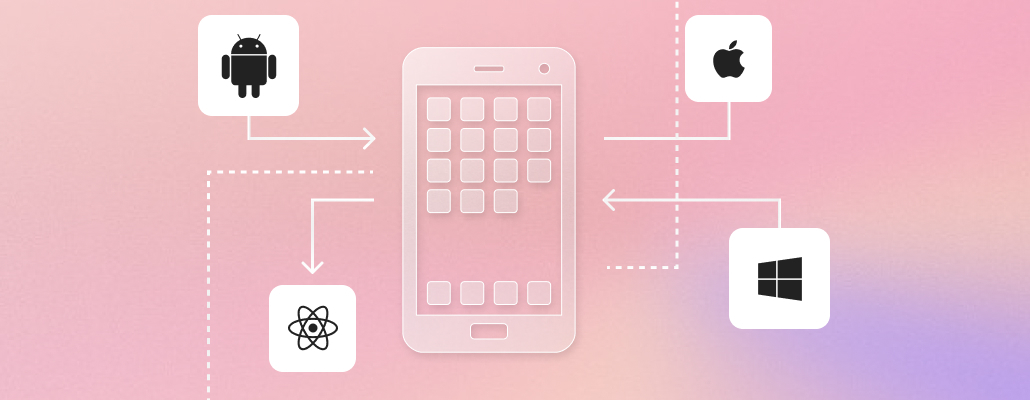
A cross-platform program will run on Microsoft Windows, Linux, and macOS, or two of them. A great example is a web browser or Adobe Flash that does the same, regardless of the computer or mobile device you use to run it. This JavaScript framework for app has become a great tool for specialized app development, allowing developers to build mobile apps that provide the performance and look, and feel of native apps using familiar development tools.
Benefits of React
The following are a few of its prominent advantages
-
Code Portability & Reusability: Single codebase on iOS, Android, and web.
-
Pre-built Libraries & Community: Massive open-source community.
-
Good Development Process: Shared resources for mobile and web teams.
-
Sane Maintenance & Updates: Faster iterations with centralized code management.
-
Enterprise-Scale Scalability: Proven with large, high-resilience apps.
RN app architecture allows development teams to create one codebase that works smoothly on iOS, Android, and the web. This leads to great code reuse and portability.
Important Points to Consider for Building Cross-Platform Solutions with React Native
One of the biggest advantages of Cross-Platform Solutions with React Native is faster time-to-market. This open-source framework has numerous benefits but also includes considerations that impact long-term maintainability, complexity of integration, and compliance needs.
Compatibility with OS Updates
One issue with this open-source framework is the delay in supporting new operating system updates and hardware changes. In native development, updates are immediate. But with this framework, developers must wait for the maintainers and community to release compatibility patches. This delay can cause temporary issues, especially after major OS updates with new features or UI changes.
Security & Compliance
Secure and compliant app development requires active risk management.
Key security considerations
-
Data encryption for secure storage and transit
-
Secure authentication protocols like biometrics and multi-factor authentication
-
Code obfuscation and reverse engineering prevention techniques
-
Daily dependency scanning to minimize risks associated with third-party libraries
-
Compliance with industry standards, i.e., GDPR, HIPAA, and PCI-DSS
By including these security controls during early development cycles, organizations are able to minimize risks.
Cost Efficiency
Cross-Platform Solutions with React Native save time, cut costs, and boost performance across devices. Through the enablement of a single codebase for Android and iOS, businesses can significantly reduce resource allocation, maintenance expenses, and time-to-market, gaining a much-improved return on investment.
Key cost-saving benefits are
-
Single development team, reducing hiring and operating expenses.
-
Shorter development cycles by reusing components.
-
Less infrastructure expense from reduced backend complexity.
-
Smooth updates via over-the-air distribution, minimizing app store approval delay.
Scalability & ROI
Shorter development time means faster go-to-market, giving businesses a competitive edge. It not only saves initial costs but also makes it easier to scale as the user base and business needs grow. Cross-Platform Solutions with React Native are perfect for startups looking to do more with less.
Most important ROI drivers
-
Reduced time-to-market with a shared codebase.
-
Reduced long-term maintenance over native alternatives.
-
Architecture scalable for expanding future growth.
Pros and Cons of Using RN
|
Aspect |
Pros |
Cons |
|
Code Reusability |
One codebase for both iOS and Android |
Platform-specific code still needed for advanced features |
|
Faster Development |
Saves time with shared components and logic |
Debugging can be complex compared to native apps |
|
Performance |
Near-native performance for most apps |
Not ideal for CPU-intensive tasks or high-end gaming apps |
|
UI Flexibility |
Uses native components, which feel like real native apps |
May require native code for complex animations |
|
Community Support |
Large, active community with lots of libraries and tools |
Some libraries may be outdated or poorly maintained |
At Tangent Technologies, we specialize in building scalable cross-platform mobile apps with RN that run efficiently. Our team uses industry best practices to ensure your app is fast, secure, and future-ready.
Conclusion
In this blog post, we covered advantages, costs, and best practices for RN. Startups often choose Cross-Platform Solutions with React Native to launch their apps quickly and on a budget. Don’t just randomly build apps. Build a wonderful experience that users require.
FAQ’s
1. What makes RN a good choice for apps?
It lets you build iOS and Android apps from a single codebase, saving time, cost, and effort.
2. Can RN handle large-scale apps?
Absolutely. With the right architecture and optimization, RN scales beautifully.
3. What are the top performance tips for RN apps?
Use lazy loading, optimize state management, minimize re-renders, and profile regularly.
4. Is it safe to use third-party libraries in this JavaScript framework for apps?
Yes, but always vet the library, check community reviews, and keep it updated.
5. What are the key architectural patterns for large-scale RN apps?
-
Modular Architecture: Break code into reusable modules
-
State Management: Use Redux, Recoil, or Zustand
-
Navigation: Employ React Navigation with stack/tab patterns
-
Service Layering: Separate API calls and business logic
6. How do you manage performance in a React-based mobile framework?
-
Lazy loading components
-
Reducing re-renders with memoization
-
Using native modules only when required
-
Optimizing images and animations